
 FR
FR  ES
ES  DE
DE  IT
IT 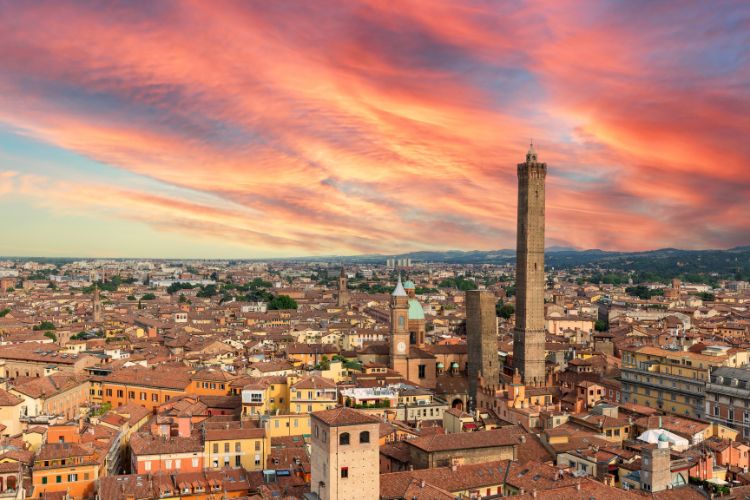
Piazza Maggiore and the Basilica of San Petronio
Piazza Maggiore is the beating heart of Bologna, a place that breathes history from every corner. Its origins date back to the 13th century, when it began to take shape as an open space for trade and community life. Today, the square retains its Renaissance structure, a remarkable example of urban planning from the era. It is here that the majestic Basilica of San Petronio, dedicated to the city's patron saint, stands. This church is not only a symbol of civic pride but also one of the largest churches in Italy, a true Gothic monument. Inside, you can admire the sundial created by Giovanni Domenico Cassini, a fascinating work that marks time in a unique way. The square itself has been the scene of countless historical and social events, making it an essential landmark for anyone visiting Bologna. It is the perfect place to begin discovering the city and its soul.
The Quadrilatero
Just outside Piazza Maggiore, the Quadrilatero unfolds, a maze of streets representing one of Bologna's oldest areas. Historically, it was the centre of artisan guilds, and even today, the street names recall those ancient activities. Today, this district is a lively medieval market, full of food shops and eateries where you can savour typical Bolognese dishes or simply enjoy an aperitif. Wandering through the Quadrilatero means immersing yourself in an authentic atmosphere, amidst scents and flavours that tell the city's culinary story. It is a sensory experience not to be missed.
Palazzo d’Accursio
Overlooking Piazza Maggiore, Palazzo d’Accursio, also known as Palazzo Comunale, is a building that has embodied Bologna's political power since 1336. Its history is linked to the jurist Accursio, whose birthplace gave rise to the imposing structure we see today. Inside, you can visit frescoed halls such as the Sala d’Ercole and the Sala Farnese, which bear witness to the palace's artistic and historical richness. One of the most interesting attractions is the Clock Tower, from the top of which you can enjoy a suggestive view of the square and the city's rooftops. The Tower, along with the Civic Art Collections, offers a glimpse into Bolognese life and art through the centuries. The nearby Sala Borsa Library, once the seat of the Bologna Stock Exchange, is now a multimedia space where students and citizens meet, a place that combines history and modernity.
Icons of Bologna
The Two Towers: Asinelli and Garisenda
You cannot think of Bologna without immediately picturing its two towers, the undisputed symbol of the city. The Asinelli Tower, the taller one, offers a breathtaking view of the entire Bolognese panorama, but be prepared for quite a few steps. Its neighbour, the Garisenda Tower, is shorter and leaning, so much so that it is nicknamed 'the twisted one'. Their history is linked to that of the noble Bolognese families of the Middle Ages, who built them as a symbol of their power. Walking at their feet truly takes you back in time.
The Sanctuary of Santa Maria della Vita
This place is a real gem, often overlooked by more hurried tours. Inside the Sanctuary, you will find Niccolò dell'Arca's Lamentation over the Dead Christ, a sculptural group of incredible expressive power. The figures seem almost to come to life, with a realism that strikes straight to the heart. It is a work that deserves careful attention to appreciate the artist's mastery and the emotion it conveys.
A Dive into History and Culture
Bologna is not just about porticoes and gastronomy; there is a side of the city that takes you back in time, between ancient knowledge and moving art. If you truly want to understand this city, you must visit these places.
The Archiginnasio and the Anatomical Theatre
This place is incredible. It was the main seat of the University of Bologna, one of the oldest in the world. Upon entering, you find yourself in a courtyard full of coats of arms, telling stories of students and professors from centuries past. But the real gem is the Anatomical Theatre. Imagine an amphitheatre-shaped room, all in wood, where doctors studied anatomy. It is an experience that makes you feel part of a long tradition of study and discovery. It is a journey into the history of medicine and education that will leave you speechless.
The National Art Gallery
If you love art, the National Art Gallery is a must-visit. Here you will find an amazing collection of Emilian painting from the 13th to the 18th century. There are works by artists such as Giotto, Raphael, and Titian, but especially by Bolognese masters like Guido Reni and Guercino. It is a perfect way to see the evolution of art in this region, with works that speak to you directly from the past.
The Museum of Modern Art (MAMbo)
For those who prefer more recent art, MAMbo is the right place. Housed in a former bakery, this museum collects Italian art from the post-World War II period onwards. There are temporary exhibitions by famous artists and a permanent collection that makes you reflect on the contemporary world. It is an interesting contrast to the historic buildings, but it shows how Bologna is a vibrant city that also looks to the future.
Hidden Treasures and Evocative Panoramas
The Complex of the Seven Churches
Beyond the beaten paths, Bologna hides places that require a bit more exploration. The Complex of the Seven Churches, also known as Santo Stefano, is one of them. It is not a single church but a collection of sacred buildings that developed over the centuries, creating an almost monastic atmosphere in the heart of the city. Walking through its courtyards and chapels is like taking a journey back in time, discovering architectural and spiritual details that escape a hurried visit. Every corner tells a story, a fragment of Bologna's long religious history.
The Little Window of Via Piella
If you are looking for a corner that will make you exclaim, "This is Venice!", then the little window of Via Piella is the place to go. It is a small opening overlooking one of the few stretches of canal still visible in the city, the Canale delle Moline. It is an unexpected detail, a small glimpse of water winding between buildings, recalling a past when canals were important communication routes. It is a perfect spot for a souvenir photo, a little secret that Bologna reveals to its most attentive visitors.
The Sanctuary of the Madonna di San Luca
For a breathtaking panorama, there is nothing better than climbing to the Sanctuary of the Madonna di San Luca. The route itself is an experience: it winds along the longest portico in the world, an imposing structure that connects the city to the sanctuary located on the hilltop. The climb, whether on foot or by transport, is rewarded by the stunning view of Bologna and the surrounding plain. The sanctuary itself is a place of great devotion and beauty, but it is the perspective from above that makes this visit truly unforgettable.
Beyond the Historic Centre
Bologna is not just its beating heart of porticoes and historic squares. For those with time and a desire to explore a little deeper, there are less-trodden but equally fascinating corners. Consider, for example, the Bolognese Hills, a green area that extends just outside the city, offering panoramic views and a more tranquil atmosphere. Climbing towards the Sanctuary of the Madonna di San Luca, perhaps walking along the long portico that starts from the city, is an almost mystical experience, offering an unparalleled view of the entire surrounding landscape. It is a different way to experience Bologna, away from the crowds but no less intense.
And then, for motor enthusiasts, Bologna and its surroundings are a true paradise. The Emilian Motor Valley is famous worldwide, and here you can visit museums dedicated to iconic brands such as Ferrari, Lamborghini, and Ducati. These are places that tell a story of engineering, passion, and Italian design, capable of exciting even those who are not experts in the field. An immersion into a world of speed and innovation that completes the picture of an incredibly rich and varied territory.
The Bolognese Gastronomic Experience
Bologna is known worldwide as "La Grassa" (The Fat One), and there is a reason for that. Its cuisine is rich, flavourful, and deeply rooted in tradition. You cannot visit this city without dedicating time to discovering its unique flavours. From fresh handmade pasta, such as the famous tortellini served in broth or with ragù, to tagliatelle that accompany a rich and hearty sauce, every dish tells a story. Let's not forget mortadella, a cured meat that reaches peaks of excellence here, often enjoyed with crescentine, a light and crispy fried bread. The cotoletta alla bolognese also deserves a special mention, a local version that adds ham and cheese to a breaded and fried cutlet. For a complete immersion, taking part in local cooking classes is an excellent idea to learn the secrets of these preparations. The Quadrilatero Market, then, is a place where the senses are stimulated by the colours, scents, and flavours of fresh produce, a true pulsating heart of Bolognese gastronomy, where you can taste and buy the best specialities. Every corner of Bologna offers an opportunity to savour the true essence of Emilian cuisine.
Frequently Asked Questions
What is the best way to get around Bologna?
Bologna is a perfect city to explore on foot, thanks to its famous porticoes that protect you from the sun and rain. Alternatively, you can use a bicycle to get around faster and discover areas a little further from the centre.
What absolutely must I not miss in Bologna?
You absolutely must see Piazza Maggiore with the Basilica of San Petronio, the iconic Two Towers (Asinelli and Garisenda), and the lively Quadrilatero, a historic market full of flavours. The Sanctuary of San Luca, reachable via the longest portico in the world, is also a unique experience.
Are there any special places to see for art lovers?
Yes, Bologna offers a lot! The Archiginnasio with its Anatomical Theatre is fascinating, the National Art Gallery has many important paintings, and MAMbo is the right place for modern art. Each museum tells a different part of the city's history and culture.
What is good to eat in Bologna?
Bologna is famous for its food! You can't leave without trying tagliatelle al ragù, lasagne, mortadella, and cotoletta alla bolognese. The Quadrilatero Market is the ideal place to taste local products.
Is it true that there are hidden secrets in Bologna?
Absolutely! Bologna is full of little curiosities, like the little window in Via Piella that resembles the canals of Venice, or the statue of Neptune. Exploring the city means discovering many little stories and legends.
Can I climb the Two Towers?
The Asinelli Tower is open to the public, and climbing its nearly 500 steps offers a breathtaking view of the city. The Garisenda Tower, however, is more leaning and cannot be visited inside. Remember that students sometimes avoid climbing it before graduation for good luck!