
 FR
FR  ES
ES  DE
DE  IT
IT 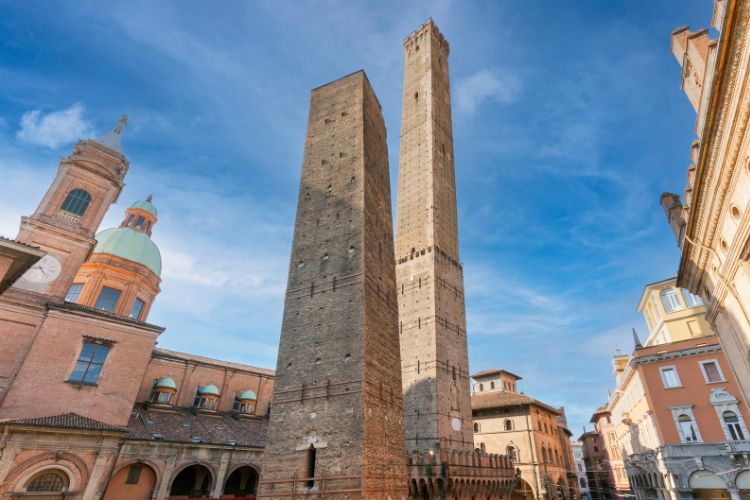
The Two Towers, the Garisenda and the Asinelli, are undoubtedly Bologna's most recognisable symbol. They are not just tall buildings, but true monuments that tell an ancient story. Built in the Middle Ages, these structures had a very specific purpose: besides serving as lookout and defence points, they also represented the power and prestige of the families who erected them. Imagine Bologna in the 12th century, a city full of these towers, so much so that it was nicknamed "la Turrita" (the Towered City).
They were a sign of wealth and influence, a way for noble families to make their mark on the urban landscape.
Their presence defined the city's landscape and identity itself. Today, although many have disappeared, the Garisenda and Asinelli remain as testaments to that glorious past, offering a glimpse into an era of competition and ambition. Their construction, which took place between 1109 and the 12th century, is linked to important families such as the Asinelli, who have left an indelible mark on the city. They are a piece of Bolognese history that can still be admired while strolling through the city centre, a true
monument
to the city's history.
The Towers in the Medieval Context
In the Middle Ages, Bologna was a veritable forest of towers. It is estimated that there were over a hundred, an impressive number that made the city unique. These towers were not just buildings, but true status symbols. The wealthiest and most powerful families built them to demonstrate their strength and power. It was a kind of architectural and social competition. Their height and imposing nature served to impress visitors and consolidate their position within society. In addition to this symbolic aspect, they also had practical functions. They were used for defence, as observation points to spot approaching dangers or enemies, and sometimes even as fortified dwellings. Their presence was so widespread that Bologna earned the nickname "Bologna Turrita". The Two Towers we see today, the Garisenda and the Asinelli, are the most famous and best-preserved from this period, but they represent only a small part of what the medieval urban landscape must have been like. They are a tangible reminder of an era when verticality defined power and security. If you are interested in learning more about this aspect, you can consult a map of the
to get an idea of their prevalence.
The Asinelli Tower
Construction and Height
The Asinelli Tower, built between 1109 and 1119 by the family of the same name, is the taller of the two Bolognese towers. It reaches about 97 metres in height! To climb to the top, there are almost 500 steps, quite a climb for those who enjoy walking. It was initially a little shorter, but was later raised. Its structure is solid, although it has suffered damage over time, such as fires and lightning strikes, so much so that in 1824 they decided to install a lightning rod. It has stood for centuries, a true witness to Bologna's history.
Visibility and Panorama
Once you reach the top of the Asinelli Tower, after all the effort with the stairs, the view that opens up is truly special. You can see all of Bologna, with its red roofs and the other towers dotted here and there. It's a panorama that makes you appreciate how beautiful the city is from above. It is said that in the past, during the Second World War, it was used as an observation point to direct rescue operations in case of bombings. Imagine the responsibility!
Historical and Scientific Uses
The Asinelli Tower was not just a symbol or an observation point. Over the centuries, it has had many uses. It was used as a prison, a fortress, and even as a base for scientific experiments. In the 17th and 18th centuries, some scientists used it to study the motion of heavy bodies and the rotation of the Earth. Serious stuff! Then, more recently, it also served as a support for a television antenna. In short, this tower has seen and done it all.
The Garisenda Tower
Characteristics and Inclination
The Garisenda Tower, built in the same period as its taller neighbour, the Asinelli Tower, stands today at a height of about 47 metres. What makes it truly unique, however, is its marked inclination, which exceeds 4 degrees. This tilt, which makes it seem almost on the verge of falling, is due to problems from the foundations and the subsidence of the ground on which it rests. It appears that this characteristic was present from its construction, or at least from the 13th century. It was initially even taller, but in the 14th century it was shortened for fear that it might collapse. Its unique shape has made it famous, so much so that it has been cited by great authors such as Dante Alighieri in the Divine Comedy, a reference that highlights its
singularity
in the medieval landscape. Its history is complex, and today it is the subject of important restoration work to ensure its stability. Its proximity to the Asinelli Tower makes it an iconic element of the urban landscape, a symbol of Bologna that attracts attention for its particular conformation. Its history has been widely discussed, making it a
.
The Tower in Literature
The Garisenda Tower is not just an imposing architectural structure, but it also holds a special place in Italian literature and beyond. Its very evident inclination has captured the imagination of many, so much so that it has been immortalised in famous verses. Dante Alighieri, for example, mentions it in Canto XXXI of the Inferno of his Divine Comedy, comparing its tilt to that of a giant. This reference not only attests to its fame in the Middle Ages but also highlights its visual and symbolic impact. Other authors, such as Goethe in his 'Italian Journey', have also mentioned the tower, recognising its uniqueness. These literary citations contribute to creating an almost mythical aura around the Garisenda, transforming it from a simple building into a cultural icon.
Current Status and Restoration
Currently, the Garisenda Tower is at the centre of a major restoration operation. Due to its significant inclination and concerns about its stability, the tower has been closed to the public, and work is underway to ensure its safety. This is a complex and long-term intervention, aimed at consolidating the structure without altering its historical characteristics. The goal is to preserve this symbol of Bologna for future generations, addressing the engineering challenges posed by its particular condition. The work began in October 2023 and is expected to take several years to complete, with a significant investment for the city.
Practical Information for Your Visit
Address and Contacts
The Two Towers are located in the heart of Bologna, in Piazza di Porta Ravegnana. For any information or to book your visit, you can contact the Bologna Welcome tourist office, located at Piazza Maggiore 1/e. Their telephone number is +39 051 658 3111, or you can send an email to
Opening Hours and Tickets
Currently, the Asinelli Tower is closed due to monitoring work on the Garisenda Tower, which will also involve the delimitation of an area around the tower with some traffic diversions. When the tower was open, visits were on a
timed
entry basis, with new groups admitted every 20 minutes. It was essential to arrive at the entrance 5 minutes before your scheduled visit time. Tickets could be purchased online on the official website or at the Bologna Welcome Point. Prices varied, with a full ticket usually around 5 euros and concessions for certain categories. We recommend checking the official website for updates on opening hours and reopening.
Guided Tours Available
For those who wish to delve deeper into the history and curiosities of the towers, various guided tour options are available. Some tours include access to the Asinelli Tower and even tastings of typical Bolognese products. Other more extensive tours may also cover Piazza Maggiore and other city monuments, with the possibility of booking attraction tickets. These experiences are often organised through platforms that offer tours and activities throughout Italy, making it easy to find an option that suits your needs. Exploring the towers with a guide can truly enrich your
.
The Towers of Bologna Through Time
'La Bologna Turrita' (The Towered Bologna)
Bologna in the Middle Ages was a very different place from what we know today. We are talking about a period when the city was packed with towers, a veritable stone skyline soaring towards the sky. It is estimated that there were over a hundred! Imagine, a veritable forest of towers dominating the urban landscape. These constructions were not just a way to show how rich and powerful a family was, but also served practical purposes, such as defence and signalling. It was an era when competition between noble families was literally measured in height.
The city was so famous for its towers that it was called "la Turrita"
, a nickname that conveys the idea well. Today we see only a small part of them, but those that remain, like our beloved Garisenda and Asinelli, still tell us stories of that distant past.
Evolution of the Two Towers
Our two towers, the Garisenda and the Asinelli, have survived centuries of history, but not without changes. The Garisenda, right from the start, showed some problems. The ground on which it rests was not the best, and the tower began to tilt considerably. As early as the 14th century, to prevent it from collapsing entirely, they had to cut off a piece, lowering it. This pronounced
tilt
even inspired Dante Alighieri, who mentioned it in the Divine Comedy. The Asinelli, on the other hand, remained straighter and more imposing, becoming a landmark for the city over time, also used for scientific observations and as a bell tower. Both, however, have seen generations pass, political and social changes, always remaining there, bearing witness to the grandeur of medieval Bologna.
Frequently Asked Questions
Why are the towers of Bologna famous?
The Two Towers, the Garisenda and the Asinelli, are the symbol of Bologna. They are famous because they are very old, built in the Middle Ages, and they are a bit crooked, especially the Garisenda. They represent the history and identity of the city.
How tall are the towers?
The Asinelli Tower is the tallest, measuring almost 98 metres. The Garisenda Tower is much shorter, about 47 metres. Imagine that the Asinelli Tower is as tall as a building of about 30 floors!
Can you climb the Asinelli Tower?
Yes, you can climb the Asinelli Tower! There are almost 500 steps to climb, but once at the top, you can see all of Bologna from above. It's a wonderful experience.
Why is the Garisenda Tower so crooked?
The Garisenda Tower is crooked because the ground on which it was built was not stable and the foundations have subsided a bit. It has been leaning since it was built, but it has become even more crooked over time.
What was happening in Bologna with all those towers?
In the Middle Ages, Bologna was called 'la Turrita' because there were so many towers, over a hundred! They were used both for defence, as lookout towers, and to show how rich and powerful a family was. They were a bit like luxury palaces for noble families.
Can I visit both towers?
At the moment, only the Asinelli Tower is open for visits. The Garisenda Tower is closed because it is undergoing restoration and work is being done to make it safe, as it leans a lot and there is a risk it could fall.