
 FR
FR  ES
ES  DE
DE  IT
IT 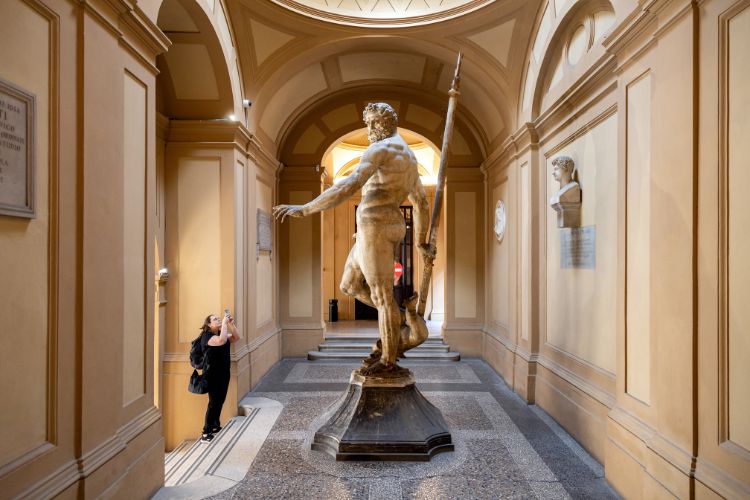
The Civic Archaeological Museum of Bologna boasts a history that dates back to 1881, the year of its official inauguration. Its creation was the result of the merger of two important pre-existing museum entities: the ancient University Museum, heir to the "Chamber of Antiquities" of the Institute of Sciences, and the more recent Municipal Museum, established just ten years earlier. The latter already housed part of the Palagi collection, donated to the Municipality, and grave goods from the Certosa burial ground, whose excavations were in full swing. The establishment of the new Archaeological Museum was also conceived to accommodate the growing number of artefacts emerging from archaeological excavations conducted in and around Bologna, covering a period from the early Iron Age to the Roman era. Many of the internal spaces still retain their 19th-century appearance and layout, a deliberate choice to preserve a valuable example of post-unification Italian museography.
Palazzo Galvani: The Historic Seat
The building that houses the Civic Archaeological Museum is the historic Palazzo Galvani, an edifice dating back to the 14th century. Originally built in 1336, it became the seat of the Hospital of Santa Maria della Morte and its confraternity in 1347. Although only parts of the original structure remain, the palace represents an architecturally fascinating setting that has housed the museum's precious collections for over a century, offering visitors an immersive historical experience.
The Civic Archaeological Museum in Brief
The Civic Archaeological Museum of Bologna is an essential point of reference for anyone wishing to deepen their knowledge of the historical roots of the Emilia region and beyond. Its collections span a vast chronological period, from prehistory to the Roman era, with a particular focus on local history. Until 1985, the museum also included a section dedicated to the Middle Ages and the modern era, which was later incorporated into the Civic Medieval Museum. Today, the museum is distinguished by the richness of its sections, which include prehistoric, Etruscan, Gallic, and Roman artefacts, as well as important Egyptian, Greek, and numismatic collections, making it a true treasure trove of the past.
The Museum's Main Collections
The Archaeological Museum of Bologna houses a heritage spanning millennia of history, offering an in-depth look at the civilisations that have shaped the region and beyond. Its halls are organised by historical periods and geographical areas, making a visit a true journey through time.
Prehistoric and Protohistoric Section
Here, we begin at the origins, with artefacts covering a vast chronological span, from the Palaeolithic to the Bronze Age. You can admire stone and metal tools, ceramics, and artefacts that tell the story of the daily lives and early forms of social organisation of our ancestors. It's a dive into the deepest roots of human presence in these lands.
Etruscan and Gallic Civilisation
Bologna, or Felsina as it was known, was an important Etruscan centre, and the museum preserves significant evidence of this. Tomb furnishings, everyday objects, and weapons offer a glimpse into their culture and way of life. The Gallic collection, on the other hand, documents the arrival and settlement of these peoples, showing how cultures intertwined and transformed over the centuries. It is a fascinating dialogue between peoples and traditions.
Artefacts from the Roman Era
The Roman era is widely represented with statues, portraits, everyday objects, inscriptions, and tombstones. These artefacts tell us about life in the Roman colony of Bononia, its infrastructure, and its administration. The statue of Nero and the milestones of the Via Emilia are just a few of the pieces that capture attention, offering a tangible link to the imperial past. You can also explore life in Roman workshops through the documents on display.
Treasures from Distant Lands
In addition to artefacts that tell the local story, the Archaeological Museum of Bologna also houses evidence of civilisations from much further afield. Among these, the prestigious Egyptian collection undoubtedly stands out, one of the most important in Europe. It extends over an entire floor, presenting over 3,500 objects that trace the history of ancient Egypt, from the Old Kingdom to the Ptolemaic period. It is a fascinating journey through sarcophagi, amulets, and everyday objects that speak of beliefs and daily life from millennia ago. No less interesting is the Greek collection, which includes works such as a copy of the head of Athena Lemnia, as well as gems and ceramics that testify to the artistic skill of that period. The numismatic collection also deserves attention, offering a glimpse into history through coins. You can explore part of these collections online, thanks to the database available on the museum's official website, which includes detailed descriptions and photos of approximately 2,500 objects, including those from the Greek, Egyptian, and numismatic sections. This allows for an initial encounter with these treasures even before a physical visit, perhaps to decide which artefacts to view more closely once you arrive at the museum, which houses a rich series of artefacts spanning various eras and cultures.
Beyond the Permanent Collections
The Archaeological Museum of Bologna does not limit itself to displaying artefacts from its historical collections but also offers spaces dedicated to experiences that go beyond the ordinary. The Gipsoteca (Plaster Cast Gallery) is a notable example, a veritable archive of plaster casts that faithfully reproduce masterpieces of Greek and Roman sculpture. It is a fascinating way to study and admire the forms and details of famous works, even without access to the original. In addition to this, the museum is a vibrant centre of cultural activities. Temporary exhibitions are a regular fixture and often explore specific themes, delving into historical periods, civilisations, or particular aspects of archaeological heritage, both local and international. These events change regularly, so it is always worth checking the updated programme to discover the new exhibitions and opportunities for deeper learning that the museum offers its visitors.
Practical Information for Your Visit
Opening Hours and Closing Days
To best plan your trip to the Archaeological Museum of Bologna, it is useful to know the opening hours. Generally, the museum opens its doors around 10:00 AM and closes around 7:00 PM, but these times may vary slightly between the summer and winter periods. It is always a good idea to check the official website for the most up-to-date information, especially regarding summer and winter hours. Please note that the ticket office closes one hour before the museum's closing time. As for closing days, the museum observes a weekly closure on Tuesdays, unless it falls on a public holiday. Additionally, there are scheduled closures for major national holidays, such as 1st May and 25th December. Remember that this information is subject to change, so a quick online check before your visit is always recommended.
Ticket Prices and Free Admission
Admission to the Archaeological Museum of Bologna has a cost that varies depending on the type of ticket. The full price ticket is usually around €6, but there are various concessions available for students, young people between 18 and 25 years old (often around €2-3), and other specific categories. For those seeking greater flexibility, there is also an 'Open' ticket which costs slightly more but allows access at a time of your choosing. Regarding free admission, historically there were benefits such as the first Sundays of the month or the last hours of Thursday, but these have been suspended and not always reinstated, so it is best to inquire. The Bologna Welcome Card or the Card Cultura may offer free or discounted entry, as well as other specific conditions to verify. Tickets, for both permanent collections and temporary exhibitions, can be purchased online through dedicated platforms, which can save time at the entrance.
How to Reach the Museum
The Archaeological Museum of Bologna is located in a rather central position, precisely at Via dell’Archiginnasio 2, within the prestigious Palazzo Galvani. This makes it easily accessible by various means. If you arrive by train, from Bologna's central station you can take a bus or enjoy a walk of about 15-20 minutes. The area is well served by public transport, so consulting local bus timetables and routes is an excellent strategy. For those travelling by car, it is important to know that Bologna's historic centre has ZTL (Limited Traffic Zones), so it is advisable to park in one of the external park-and-ride facilities or in a partner car park and then continue on foot or by public transport. Its proximity to other city centre attractions makes the museum an ideal starting or ending point for exploring the city.
Digital and Educational Experiences
The Archaeological Museum of Bologna Online
The Archaeological Museum of Bologna is not confined to its physical walls; it has made significant strides in making its collections accessible to those who cannot visit in person. Since November 2024, a significant portion of the museum's heritage has been available on Google Arts & Culture. Here, over 120 works from the permanent collections are presented in an immersive way, accompanied by five thematic stories that explore the history of Bologna and its territory through the centuries. It is a truly interesting way to get an idea of what the museum offers, directly from your computer or tablet. For those interested in technologies applied to the conservation of cultural heritage, there are courses exploring innovative digital solutions for safeguarding and promoting cultural assets.
Educational Activities and Workshops
For schools and anyone interested in more interactive learning, the museum organises various educational activities. These include guided tours specifically designed for school groups and practical workshops that allow for a deeper exploration of specific themes related to the collections. The museum is committed to making the educational experience as engaging as possible, adapting content to different age groups and knowledge levels. Detailed information on activities and booking procedures can be found on the museum's official website, which often directs to dedicated platforms for managing registrations. The aim is to transform the visit into an opportunity for active and participatory discovery.
Frequently Asked Questions
What is the Archaeological Museum of Bologna and why visit it?
The Archaeological Museum of Bologna is a fantastic place to discover ancient history, from the earliest eras right up to Roman times. It's like a journey through time that helps you better understand the origins of our land. There are incredible artefacts that tell stories of peoples who lived long ago.
What are the most important things to see in the museum?
The museum has so many interesting things! There's a section dedicated to Prehistory with stone tools and bones, then you move on to the Etruscans and Gauls with objects from their tombs. Don't miss the rich Roman collection with statues and everyday objects, and then there's the famous Egyptian collection, one of the most important in Europe, with sarcophagi and mummies.
Is the museum suitable for those who are not archaeology experts?
Absolutely! The museum is organised in a way that makes the visit interesting for everyone. There are panels that explain things simply, and if you want to learn more, you can download a guide from the website. It's a great opportunity to learn new things while having fun.
How long does it take to visit the museum?
To see the main things properly, allow at least an hour and a half to two hours. If you want to spend more time in certain sections or participate in a workshop, you might need more time. The ideal duration depends on how curious you are!
Are there special activities for children or schools?
Yes, the museum also caters to younger visitors! They organise workshops and guided tours specifically designed for schools and families. They are a super fun way to introduce history to children and get them interested in archaeology.
Where is the museum located and how do you get there?
The museum is located right in the centre of Bologna, at Via dell’Archiginnasio 2, inside a splendid historic building called Palazzo Galvani. It's easy to reach on foot from Piazza Maggiore. If you're coming from outside the city, you can use public transport or park nearby.