
 FR
FR  ES
ES  DE
DE  IT
IT 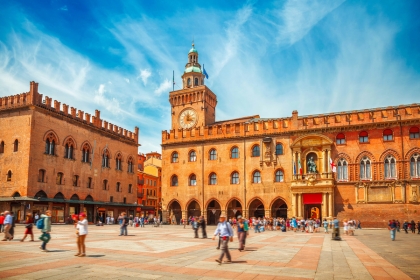
Piazza Maggiore has always been the nerve centre of Bologna, a place that pulses with life and history. It is not just a physical space, but the true beating heart of the city, where Bolognese people meet, stroll, and experience the most important moments. Its origins date back to the 13th century, when the Municipality decided to create a large open space, acquiring and demolishing existing buildings to give life to what would become the Platea communis, the square of the people and the government. Imagine a time when this vast area welcomed thousands of people to witness public events, a true open-air lounge. Today, despite having changed its appearance and functions over the centuries, Piazza Maggiore retains its soul as a vital centre, a place where imposing architecture blends with the daily energy of its inhabitants.
Medieval origins and urban transformations
The history of Piazza Maggiore is a story of continuous evolution. Born in the 13th century as a space for civic functions and commercial exchanges, the square has seen modifications and additions that have shaped its current appearance. The Municipality's acquisition of land marked the beginning of an ambitious project: to create a place that represented the city's power and, at the same time, a gathering point for the population. Over the centuries, historic buildings such as the Palazzo del Podestà, the Palazzo d'Accursio, and the majestic Basilica of San Petronio rose along its perimeters, defining its grandeur and importance. Each era has left its mark, transforming the square from a simple medieval market into the monumental setting we admire today, a true open-air museum that testifies to Bologna's historical richness.
Events and vibrant atmosphere
Piazza Maggiore is not just a historical monument, but a constantly lively stage. Throughout the year, it comes alive with a myriad of events that attract Bolognese residents and visitors alike. From cultural events to city celebrations, the square is the chosen venue for sharing moments of joy and togetherness. In summer, for example, it transforms into an open-air cinema with the "Sotto le Stelle del Cinema" (Under the Stars of Cinema) festival, a now traditional event that fills the evenings with magic. The atmosphere is always electric, a mix of history, art, and daily life. Walking here means immersing yourself in a unique environment, where the murmur of people blends with the sound of street performers, creating a soundscape that makes every visit an unforgettable experience. This is the true spirit of Piazza Maggiore: a place that never sleeps, always ready to welcome and amaze.
Architectures that define the square
The majestic Basilica of San Petronio
The Basilica of San Petronio is undoubtedly the most imposing building overlooking Piazza Maggiore. Its construction, begun in the 14th century, was originally intended to surpass even St. Peter's in Rome in size. Unfortunately, the project was scaled down, leaving the facade in a state of incompletion which, however, gives it a unique charm. The lower part is covered with polychrome marble, while the upper part remains exposed, in rough brick. This chromatic contrast is particularly striking, especially during sunset hours. Inside, the basilica houses valuable works of art and the famous Cassini Meridian, a fascinating astronomical testament.
Palazzo del Podestà and its archway
Opposite the basilica stands the Palazzo del Podestà, one of the oldest buildings in the square, dating back to the early 13th century. Its most distinctive feature is the large archway that crosses the ground floor, connecting different parts of the block. This covered space, once the scene of public events and even capital executions, is now a lively thoroughfare. It is said that if you speak in a whisper facing one pillar, your words will be clearly heard by someone facing the opposite pillar, a small acoustic mystery that adds to the charm of the place. The Palazzo del Podestà is a key element of the complex of historic buildings surrounding the square.
Palazzo dei Banchi and its porticoed facade
Completing the perimeter of the square, we find the Palazzo dei Banchi. Built in the 15th century, it owes its name to its original function as the seat of bankers. Its current appearance is largely due to the interventions of Vignola, who designed its imposing porticoed facade. This continuous portico not only gives a sense of architectural unity to the side of the square but also offers elegant shelter from the sun and rain, inviting passers-by to stroll beneath its arches.
Historic buildings and civic power
The Palazzo dei Notai and its coat of arms
Next to the Basilica of San Petronio stands the Palazzo dei Notai. Its facade still bears the coat of arms of the notaries' guild, a symbol that recalls the importance of this profession in city life. It was a place where activities related to the profession took place, a reference point for documentation and official acts.
The Palazzo del Comune and Palazzo d'Accursio
Continuing along the perimeter of the square, one encounters the Palazzo del Comune complex. The oldest nucleus is represented by Palazzo d'Accursio, which takes its name from the jurist Accursio who lived there. This building, expanded over time, has been the centre of Bolognese civic power for centuries. Its facades are enriched with sculptures, including the Madonna and Child by Niccolò dell'Arca, and a 16th-century portal.
The statue of Gregory XIII
Above the portal of Palazzo d'Accursio, in 1580, a bronze statue of Pope Gregory XIII was placed. This pontiff, belonging to the Bolognese Boncompagni family, is remembered for his role in the reform of the Gregorian calendar. His presence on the facade of the town hall underscores the historical link between the city and the Church.
Palazzo Re Enzo and the Fountain of Neptune
The history of Palazzo Re Enzo
Right here, a short walk from the main square, stands Palazzo Re Enzo. Originally, this building was known as the "new palace," intended to house other administrative functions of the Municipality. Its fame, however, is inextricably linked to the figure of King Enzo, who spent many years there as a prisoner. His story is a fascinating chapter in Bolognese life, an intertwining of power, personal events, and legends that still resonate within these walls today.
The famous Fountain of Neptune
Between the Palazzo del Comune and Palazzo Re Enzo, a space opens up that leads directly to the Fountain of Neptune. Created around the mid-16th century, this smaller square is an ideal extension of Piazza Maggiore. At its centre stands the fountain, a work in marble and bronze created by the Flemish sculptor Giambologna. Its imposing figures and the majesty of the sea deity make it a focal point, a symbol of the city's power and wealth.
A gathering place and history
This corner of Bologna, with the palace that was a king's prison and the fountain celebrating a sea god, has become over time a place of meeting and life. It is easy to imagine the scenes that have unfolded here over the centuries, among merchants, citizens, and, of course, the melancholic figure of King Enzo. His story, made of escape attempts and a lifelong imprisonment, adds another layer of charm to this already historically and architecturally rich space.
The Basilica of San Petronio: an unfinished masterpiece
Ambitious project and scaling down
Work on what was intended to be the largest church in the Christian world began in 1390, at the behest of the Municipality. The idea was colossal, but as we know, grand plans often clash with reality and, above all, with finances. Over time, the initial project was scaled down, leaving the basilica with an appearance that still makes it unique today.
The contrasting facade of marble and brick
The facade of San Petronio is a true manifesto of this history of ambitions and compromises. The lower part is a riot of precious, carefully worked marble, while the upper part remains exposed, with red bricks telling another story, that of time and insufficient resources. It is a contrast that does not detract at all; on the contrary, it gives the basilica an unmistakable character.
Interiors, chapels, and the Meridian
Upon entering, one is greeted by three wide naves, marked by imposing pillars. The naves are surrounded by twenty-two chapels, each with its own stories and works of art. Among these, the Chapel of the Magi stands out, with frescoes by Giovanni da Modena depicting Paradise and Hell. And then there is the San Petronio Meridian, created by Gian Domenico Cassini in the 17th century: it is the longest meridian in the world, a true astronomical instrument that crosses the basilica's floor, a silent witness to the passage of time and the historical events that took place here, such as the coronation of Charles V.
King Enzo: imprisonment and Bolognese legend
Capture at the Battle of Fossalta
In 1249, Bologna faced the Modenese troops, supported by King Enzo, the natural son of Emperor Frederick II and by him appointed King of Sardinia. The Battle of Fossalta was a crucial moment: the Bolognese gained the upper hand and captured King Enzo. Despite the emperor's attempts to free his son, the city of Bologna did not yield. King Enzo was brought to Bologna and began his long stay, which would forever mark the city's history.
King Enzo's life in the new palace
The palace we know today as Palazzo Re Enzo, at the time a recently built municipal building, became the king's forced residence. It was not a harsh and cruel imprisonment, but rather a kind of "golden cage." King Enzo lived here for almost twenty-three years, a period during which his figure became inextricably linked with the events and imagination of Bologna. His presence, albeit as a prisoner, contributed to creating an aura of legend around him, transforming him into an almost romantic figure.
Death and burial in Bologna
King Enzo died in Bologna in 1272, after spending over two decades in the palace dedicated to him. His death did not mark the end of his story with the city. His body, in fact, was buried in the Basilica of San Domenico, thus remaining tied to Bologna for eternity. His long imprisonment and his death on Bolognese soil gave rise to numerous legends and tales that have been passed down through the centuries, consolidating his figure as an icon of the city.
King Enzo's escape attempt
The night of the barrel and the wine
Legend has it that on a Bolognese night in 1265, in almost total darkness broken only by silence, King Enzo, whose fate was now tied to Bologna, attempted a daring escape. Taking advantage of a moment of distraction from the guards, Enzo is said to have lowered himself from the windows of his palace, intending to hide in a large brenta, a container usually used to transport wine or grapes. The idea was simple: to blend in with the night's cargo and leave the city. It was a risky plan, but the hope of freedom drove him.
The discovery of the blonde hair
The plan, however, did not go as expected. Just as Enzo was hiding in the barrel, a woman, perhaps the only one awake in the entire city at that moment, noticed something unusual. In the dim moonlight, she saw a distinctive blonde mane peeking out of the container. She immediately realised it was King Enzo, Bologna's most famous prisoner. Without hesitation, the woman raised the alarm, shouting at the top of her lungs. The alerted guards intervened quickly, stopping the person carrying the barrel and returning the king to his imprisonment. An escape attempt interrupted at its peak, destined to become part of Bologna's history and legend, an episode also linked to the famous poem La secchia rapita.
Return to golden imprisonment
Thus, King Enzo's dream of freedom vanished that night. Despite the ingenuity of the plan, his blonde hair was his undoing, betraying him unexpectedly. He was led back to the palace that had now become his forced residence, Palazzo Re Enzo, located a short walk from Piazza Maggiore. This episode, more than others, contributed to creating the romantic and melancholic aura around the figure of the imprisoned king, an image that still fascinates visitors to the heart of Bologna today.
Frequently Asked Questions
What is Piazza Maggiore and why is it important to Bologna?
Piazza Maggiore is the heart of Bologna, a special place for all Bolognese people. It is where the most important events take place and where the true soul of the city is felt. It is one of the oldest squares in Italy, created in the 1200s to host the market and municipal meetings.
What are the most famous buildings overlooking Piazza Maggiore?
There are many beautiful historic palaces! The majestic Basilica of San Petronio, the Palazzo del Podestà with its large covered passage, the Palazzo dei Banchi with its elegant facade, the Palazzo d'Accursio (seat of the municipality), and Palazzo Re Enzo. Don't forget the Fountain of Neptune, just nearby!
What can you do in Piazza Maggiore?
You can stroll, admire the architecture, sit at a cafe, and enjoy the atmosphere. In the summer, the square transforms into an open-air cinema with the 'Sotto le Stelle del Cinema' festival, a much-loved event.
Who was King Enzo and why is he talked about in Bologna?
King Enzo was the son of Emperor Frederick II and was captured by the Bolognese in 1249. He lived as a prisoner for many years in the palace that now bears his name, near Piazza Maggiore. His story has become a legend, almost a romantic hero.
Why is the Basilica of San Petronio considered 'unfinished'?
The original project was enormous; they wanted to make it the largest church in the world! Unfortunately, due to a lack of funds, the work stopped. For this reason, the upper part of the facade remains with exposed brick, while the lower part is decorated with precious marble, creating a unique contrast.
What does the Fountain of Neptune represent?
The Fountain of Neptune is a spectacular marble and bronze statue created by Giambologna. It represents the god Neptune, a symbol of power and dominion, and is located in a small square adjacent to Piazza Maggiore, which is like an extension of the main square.