
 FR
FR  ES
ES  DE
DE  IT
IT 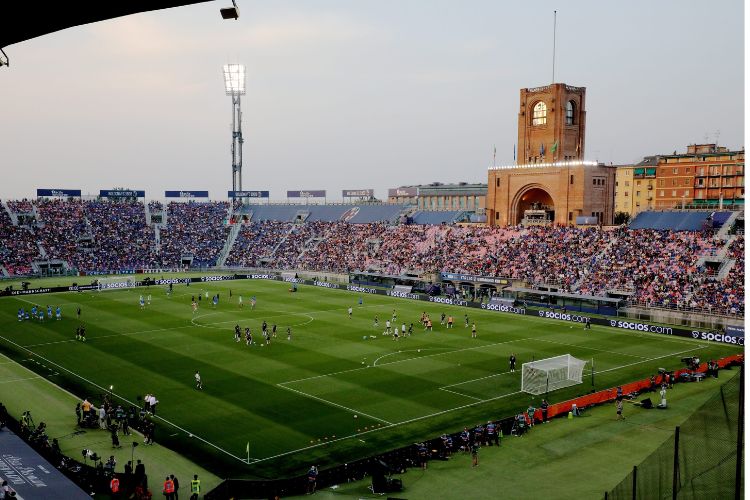
Football in Bologna has deep roots, dating back to 1909. It was in that year that a group of enthusiasts, led by Emilio Arnstein, founded Bologna Football Club. The idea was to create a sporting entity that could represent the city, and thus one of Italy's most historic teams was born. The club joined the federal championships almost immediately, in the 1910-1911 season, marking the beginning of a journey that would see the club become a protagonist. Early successes were not long in coming, with the team beginning to make a name for itself with its play and determination. The arrival of foreign coaches, such as the Austrian Hermann Felsner, helped to raise the technical level, laying the groundwork for future glories. Bolognese football was taking shape, ready to write important pages in its history.
Renato Dall'Ara Stadium: The Temple of Bolognese Football
Architecture and Historical Significance
The Renato Dall'Ara Stadium, originally known as the Littoriale, has a history that dates back to the Fascist era, having been inaugurated in 1927. It was conceived as a state-of-the-art facility for its time, not only for its considerable capacity but also for its multi-sport functions and, above all, for being the first stadium in the world equipped with floodlights for night games. After the war, the name changed to Stadio Comunale, before being renamed in 1983 in honour of Renato Dall'Ara, a historic figure and president of Bologna. Its architecture, with the characteristic Marathon Tower, has become a recognisable symbol of the city. Over the years, various adjustments have been made to comply with modern regulations, but its historical essence remains intact. The stands have been dedicated to legendary figures of the club, such as Giacomo Bulgarelli and Árpád Weisz, reinforcing the bond between the stadium and its people.
Unforgettable Moments in the Rossoblù Temple
The Dall'Ara has been the scene of countless memorable matches that have marked the history of Bologna and Italian football. From epic league clashes to European competitions, this stadium has witnessed immense joy and bitter disappointment. We recall the victories that brought league titles and cups, but also the performances that have made entire generations of fans dream. Every corner of this facility seems to tell stories of champions who have graced its pitch, of decisive goals, and of passionate support that has always driven the team forward. It is a place where the passion for football is palpable in every match, a true sanctuary for the Rossoblù supporters, capable of evoking deep emotions linked to the club's history.
Bologna Calcio in European Competitions
Bologna has a rich history of participation in European competitions, although not always with the continuity one might expect from a club with its tradition. The Rossoblù team boasts several appearances in tournaments such as the Mitropa Cup, a competition they dominated by winning it three times, a record for an Italian club. They also lifted the Central European Cup in 1932, becoming the first Italian team to win a continental trophy. More recently, Bologna participated in the UEFA Intertoto Cup, winning it in 1998, and reached advanced stages of other competitions such as the UEFA Cup. The return to the Champions League in the 2024-2025 season marks a historic moment, bringing the club back to the top European competition after more than sixty years. This achievement, reached through a remarkable journey, demonstrates the club's ability to compete at the highest levels, confirming its place in the international football landscape.
Women's Football in Bologna
Women's football in Bologna has a history that deserves attention, even if it is perhaps less well-known than the men's game. For years, the growth of the movement has been driven by the commitment of passionate individuals, such as Daniela Tavalazzi, who played a key role in the establishment and development of a women's section affiliated with Bologna F.C. 1909. This journey saw the creation of youth teams in various categories, culminating in the promotion of the first team to Serie B in 2017. Although their stay in the second tier lasted only one season, due to a league reform, the experience marked an important step. The real turning point for women's football in Bologna came in 2020, when Joey Saputo's Bologna F.C. 1909 officially acquired the sporting title, integrating the women's first team into the club structure. This move has provided new impetus, with the aim of further strengthening the presence and competitiveness of women in the city's football scene. In addition to official competitions, Bologna also stands out for its inclusion initiatives, such as the 'BFC Senza Barriere' (BFC Without Barriers) project, which offers sporting opportunities to boys and girls with disabilities, demonstrating how football can be a tool for unity and growth for all.
The Future of Bolognese Football: Challenges and Prospects
Looking ahead, the future of football in Bologna presents a path full of challenges but also great opportunities. The recent qualification for the Champions League and the victory in the Coppa Italia have marked a turning point, demonstrating the team's potential and the solidity of the technical and club project. The real challenge now is to maintain this growth trajectory, consolidating the results achieved and building a squad capable of consistently competing at the highest levels, both in Italy and in Europe. This will require targeted investments, both in the youth sector to nurture talent from within, and in the first team to bring in high-calibre players. Consideration must also be given to how to further improve facilities, such as the Casteldebole training centre, to offer players the best possible working conditions. The importance of constant dialogue with the fans, who represent the beating heart of the club, cannot be overlooked, in order to maintain that special bond that has always characterised the relationship between the city and its team. Financial sustainability will be another key factor, balancing sporting ambitions with prudent resource management. In short, Bologna's future is being built today, with vision, planning, and that passion which must never be lacking.
The Passion of the Fans: An Indissoluble Bond
The bond between Bologna and its football goes far beyond the ninety minutes of play. It is a passion passed down from generation to generation, a feeling that unites the city under the Rossoblù colours. From the very first championships, back in the early 1900s, hundreds of people would flock to watch the matches. Over time, this affection has become structured, giving rise to organised groups that still animate the Curva Andrea Costa today, the beating heart of Bolognese support. This unwavering loyalty is what makes Bologna not just a team, but a symbol for its people. It's not just about cheering, but about experiencing every match, every goal, every moment of struggle as part of one big family. The passion of the Bolognese fans is a constant element, a driving force that pushes the team forward even in the most difficult times, demonstrating an attachment that few other clubs can boast.
Frequently Asked Questions about Football in Bologna
When was Bologna Football Club founded?
Bologna Football Club was founded on 3 October 1909. It is a team with a long and rich history!
Where does Bologna play its matches?
Bologna plays its home matches at the Renato Dall'Ara Stadium, a special place for all fans.
How many times has Bologna won the league title?
Bologna has won the league title a remarkable 7 times in its history, proving to be a very strong team.
Has Bologna participated in European competitions?
Yes, Bologna has participated in various European competitions, such as the Champions League and the Europa League, making its fans dream.
What does 'Rossoblù' mean?
'Rossoblù' is Bologna's nickname, derived from the club's colours: red and blue, which are seen on the shirt.
Who are Bologna's fans?
Bologna's fans are known for their great passion and love for the team, which they follow everywhere with warmth.