
 FR
FR  ES
ES  DE
DE  IT
IT 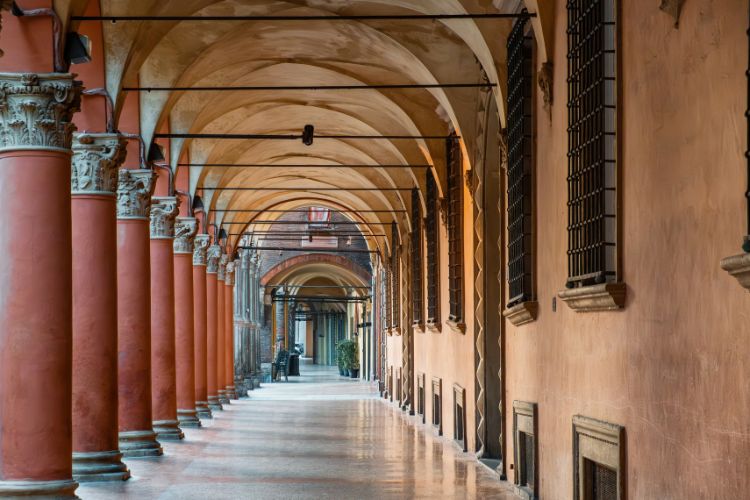
Bologna's porticoes were not born from a precise urban plan, but rather from a practical and spontaneous need. As early as the early Middle Ages, construction began in a somewhat improvised manner, with the upper parts of houses jutting out over public land. Initially, these were simple extensions of floor joists, sometimes reinforced by brackets called "beccadelli". Over time, these overhangs became larger and it became necessary to add columns to support them, thus giving rise to the first true porticoes.
This evolution allowed for an increase in living space and, at the same time, created useful shelter from the sun and rain, making the streets more passable in all weather conditions. Furthermore, from the outset, the porticoes facilitated the expansion of commercial and artisanal activities, also improving the liveability of ground floors, protected from mud and street waste.
The first historical trace of this practice dates back to 1041, testifying to how ancient these structures are that today so profoundly characterise Bologna's historic centre.
Urban Expansion and Municipal Edicts
The real impetus for the expansion of the porticoes came with the growth of the city, especially from 1288 onwards. Bologna was becoming an important centre, attracting students, scholars, and people from the countryside. To cope with this population increase and to give the city a more orderly appearance, the Municipality issued an edict.
This decree stipulated that all new constructions must include a portico, and that existing houses without a portico must add one. The burden of construction and maintenance fell on the owners, but in return, the Municipality ensured the public use of the land below. The minimum required dimensions were about 7 Bolognese feet (almost 2 metres and 70 centimetres) in height and width, enough to allow a knight to pass.
However, in poorer areas, these rules were not always respected, and much lower porticoes can be found. Subsequently, in 1352, the statutes imposed more generous dimensions for new buildings, fixing them at 10 feet (about 3 metres and 60 centimetres).
From Wooden Structures to Brick and Stone
In the beginning, most porticoes were built of wood. This material was easier to work with and cheaper. A famous example of this phase is Casa Isolani in Strada Maggiore, with its very high wooden beams dating back to the 13th century. However, over time, greater solidity and durability were sought. In 1568, a decree from the pontifical governor and the Gonfaloniere imposed the conversion of porticoes to brick or stone. Despite this change, examples of wooden porticoes can still be found in Bologna, some original from the Middle Ages, others restored in the early 20th century.
This transition from wood to stone and brick not only made the structures more resistant but also changed the appearance of the city, giving it a more monumental and lasting look.
Types and Characteristics of the Porticoes
The World's Longest Portico: San Luca
When talking about porticoes in Bologna, it is impossible not to immediately think of the San Luca one. With its almost four kilometres, it is a true architectural marvel and a symbol of the city. This imposing portico accompanies pilgrims along the climb leading to the Sanctuary, offering evocative shelter and a unique path. It is an example of how porticoes are not just functional elements, but true works of art that integrate into the landscape.
The Narrowest Portico and Other Notable Examples
Bologna is not just San Luca, of course. There are corners of the city that hold lesser-known but equally fascinating porticoes. Consider that in via Senzanome you will find what is considered the narrowest portico in the city, an almost intimate passage that tells stories of a bygone era. Then there are the more imposing ones, like the portico of Pavaglione, or those with particular decorations, which show the stylistic variety that can be found while strolling through the streets of Bologna. Each portico has its own story, its own shape, its own character. Some were built of wood, like the older ones that still stand, others of brick or stone, testifying to the evolution of construction techniques over the centuries. It is interesting to note how some noble palaces chose not to have a portico, following a different trend, but the majority of buildings have embraced this distinctive feature.
Residential, Commercial, and Academic Porticoes
The beauty of Bologna's porticoes also lies in their versatility. We find them everywhere, with different functions. There are those that accompany houses, creating a welcoming atmosphere for residents. Others line the shopping streets, inviting people to enter shops and discover artisan workshops. And then there are those linked to the academic world, such as those overlooking via Zamboni, where the comings and goings of students add a special energy. This diversity of use makes the porticoes a living and pulsating element of the city, a true common thread that binds together the different souls of Bologna. Their presence, extending for kilometres, makes them a distinctive element of many porticoed cities in Italy, but in Bologna they reach a unique scale and continuity.
Frequently Asked Questions About Bologna's Porticoes
Why are Bologna's porticoes so special?
Bologna's porticoes are unique in the world! They have been recognised by UNESCO as a World Heritage Site because there are so many of them, about 62 kilometres in total, and they have been part of the city's history and identity for centuries. They offer shelter, create spaces for walking and shopping, and make Bologna a truly special place to visit.
When did Bologna's porticoes originate?
The origins of the porticoes are quite ancient and arose almost by chance. As early as 1041, construction began in a slightly different way to gain more space. Over time, especially when many students arrived at the university, it was decided to build the porticoes in a more organised way to allow people to walk better and protect them from the sun and rain.
Who owns the porticoes?
An interesting thing about Bologna's porticoes is that, even though they are built on private land, they are intended for everyone to use, as if they were public spaces. This means that the owners take care of them, but we can all walk and enjoy them.
What is the most famous or important portico?
Among the most well-known porticoes is certainly the San Luca one, which is also the longest in the world at almost 4 kilometres! But there are many other beautiful and important porticoes, such as those surrounding Piazza Maggiore or those in via Zamboni near the university.
How has the way porticoes are built changed over time?
In the beginning, porticoes were mainly made of wood, with columns supporting them. Then, over the years, they began to be built with brick and stone, making them more solid and durable. Even today, however, some examples of the old wooden porticoes can still be seen.
What can you do under Bologna's porticoes?
You can do a bit of everything under the porticoes! They are perfect for walking regardless of the weather, for browsing the shops along the street, or simply for sitting for a moment and observing the life of the city. They are a bit like Bologna's living room, always open and welcoming.