
 FR
FR  ES
ES  DE
DE  IT
IT 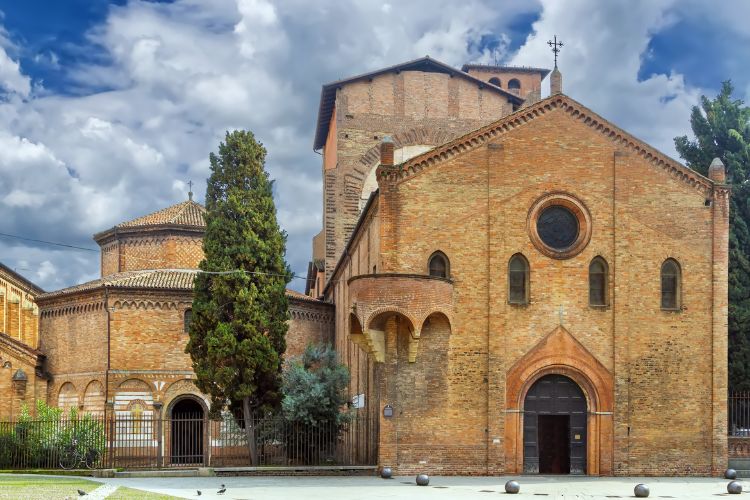
The Basilica of Santo Stefano, also known as the Seven Churches complex, dominates the piazza of the same name in Bologna. Its history is ancient and complex, with roots stretching back to Roman times. It is said that the complex stands on the site of a previous temple dedicated to the goddess Isis. The first religious structure to take shape was the church of the Holy Sepulchre, built in the 5th century. This church, with its characteristic octagonal plan, even incorporated some columns from the pre-existing Roman temple.
Subsequently, at the behest of Bishop Petronius, the church dedicated to Saints Vitalis and Agricola was built, intended to house the remains of the two martyrs. The building that now serves as the main entrance, the church of the Crucifix, dates back to the Lombard period. This layering of eras and styles makes the complex a true open-air history book, a place where different construction phases overlap, creating a unique atmosphere. Its historical importance is such that it is often described as one of the oldest religious buildings in the city, a landmark for anyone wishing to delve into the history of Bologna.
The link with Jerusalem
The Santo Stefano complex is often called the "Little Jerusalem" due to its deep symbolic connection with the holy sites of the biblical city. This link emerged particularly during the period of the Crusades. Many faithful wished to visit Jerusalem to obtain plenary indulgence, but the journey was expensive and dangerous. To overcome these difficulties, it was decided to recreate a sort of miniature "Holy Land" in Bologna, reproducing the sites of Christ's Passion. Each church and space within the complex was designed to evoke a specific place in Jerusalem, allowing pilgrims to experience intense spiritual devotion without having to undertake the long and arduous journey. This intention to evoke the sacred sites makes a visit to Santo Stefano a profoundly spiritual and historical experience, a journey through faith and history. The evocation of the Passion sites is a central aspect that distinguishes this complex from other basilicas.
Architecture and construction phases
The architecture of the Basilica of Santo Stefano is a fascinating mosaic of styles and historical periods, the result of centuries of construction and modifications. The church of the Holy Sepulchre, with its octagonal plan, is an example of early Christian architecture, reusing Roman elements such as cipollino marble columns. The church of Saints Vitalis and Agricola, on the other hand, features elements that reflect the liturgical needs of the time, while the church of the Crucifix, with its Lombard origins, adds a further historical layer. The difficulty in precisely dating the origins of the complex stems precisely from this overlap of styles and materials. Scholars have worked for a long time to reconstruct the various construction phases, identifying Roman, Byzantine, and Lombard influences. This architectural complexity is not a flaw, but a characteristic that makes Santo Stefano a site of exceptional historical and artistic interest, a true journey through the evolution of religious architecture in Italy.
Exploring the Seven Churches
The Santo Stefano complex, also known as the Seven Churches, is a truly unique place. It is not a single church, but a collection of sacred buildings that intertwine, creating a unique path. Each church has its own history and profound meaning, closely linked to the Holy Land. This place is nicknamed "Little Jerusalem"! This is because, especially in the past, when travel was difficult and dangerous, an attempt was made to recreate the holy sites of Jerusalem here to allow the faithful to have a similar spiritual experience. It is a fascinating way to connect with history and faith without leaving Bologna. The church of the Holy Sepulchre, for example, is a reproduction of Christ's tomb, and inside it also contains elements that recall the flagellation column. Then there is the church of Saints Vitalis and Agricola, which has a rather curious story linked to discovered relics and a bit of monastic... cunning. Finally, the church of the Crucifix, which welcomes us at the entrance today, dates back to the Lombard era.
Religious symbols and meanings
The Santo Stefano complex is a true journey into the Holy Land, so much so that it is nicknamed "Little Jerusalem". This designation is not accidental, but stems from the desire, arising after the Crusades, to offer the faithful the opportunity to obtain indulgence without having to undertake the dangerous and expensive journey to Jerusalem. The churches here were conceived to reproduce the sacred sites of Christ's passion.
Little Jerusalem
The idea was to recreate the most significant places of Jerusalem in Bologna. In the first church, for example, the crypt is designed to evoke the Last Supper, while the raised presbytery symbolises Pilate's tribunal. The church of the Holy Sepulchre, in turn, houses a faithful reproduction of Jesus' tomb, a place that once also served as the burial site for Saint Petronius, the city's patron saint, testifying to his deep connection with this complex.
Symbols of Christ's Passion
Inside the church of the Holy Sepulchre, there is also an isolated column, said to have been brought from the East, which represents the moment of Christ's flagellation. These architectural and symbolic elements were designed to allow pilgrims to spiritually relive the events of the Passion, making the visit a profoundly devotional experience.
The crypt and the presbytery
The crypt, in particular, is a space dedicated to prayer and meditation, a place of recollection that evokes the atmosphere of the Last Supper. The presbytery, on the other hand, with its elevated position, refers to the court where Christ was judged by Pontius Pilate. These spaces, full of meaning, invite reflection on the history of salvation.
The Museum of Santo Stefano
Collections and works of art
The Santo Stefano complex houses a museum that collects works of art and devotional objects, created following the 19th-century restorations of the site. Originally housed in the ancient Benedictine refectory, the museum changed locations several times before finding its current home. Today, it is divided into two rooms that house a significant artistic heritage. In the first room, the former Chapter House, works by artists such as Jacopo di Paolo and Vitale da Bologna can be admired, as well as a tempera by Simone Dè Crocifissi. The second room, created from the ancient Chapel of the Benda, displays precious reliquaries, including that of the head of Saint Petronius and that of the "Veil of the Virgin", as well as canvases and sculptures from the 17th and 18th centuries. Among these, works by Orazio Samacchini and Alessandro Tiarini stand out. There is also a 13th-century fresco by Borlinghiero da Lucca, which was once part of a larger decorative cycle.
The Chapel of the Benda
The Chapel of the Benda, which today houses an important part of the museum, is an area of great historical and artistic interest. Several finely crafted objects are preserved within it, including reliquaries. One of the most important is that containing the "Veil of the Virgin", dating back to 1626, a testament to Marian devotion. Other precious artefacts include works of goldsmithing, such as the reliquary of the head of Saint Petronius, created in 1380 by Jacopo Roseto. The chapel also houses canvases and sculptures that tell sacred stories, offering a glimpse into artistic production between the 17th and 18th centuries.
The sculpture of Saint Bovo
Among the artefacts preserved in the Santo Stefano museum, the wooden sculpture depicting Saint Bovo deserves special mention. Dating from the 13th to the 14th century, this work, after recent restoration, is in good condition. The carved male figure is difficult to identify immediately, but its presence enriches the exhibition, offering an example of medieval sculpture linked to the religious context of the complex.
Outdoor spaces and courtyards
The first courtyard and the Lombard basin
Leaving the churches, you find yourself in a first courtyard where an ancient Lombard-era basin stands out. It is said that this element recalls the basin in which Pontius Pilate washed his hands before the crucifixion. The church overlooking this courtyard, on the other hand, symbolises the place of the crucifixion and today houses the plaques dedicated to the fallen of the First World War. It is a place that invites reflection, a bridge between sacred history and more recent history.
The second courtyard and the cloister
Continuing on, you access the second courtyard, a cloister that develops over two orders of columns. This space is directly connected to the monastery, still inhabited today by the Olivetan Benedictine monks. Walking in this cloister gives a sense of peace and recollection, a true refuge from the hustle and bustle of the city.
The capitals and Dante's inspiration
In the upper cloister, in particular, there are capitals decorated with zoomorphic and anthropomorphic figures. Legend has it that these particular architectural elements even inspired Dante Alighieri during the writing of the Divine Comedy, offering him ideas for describing the punishments of Hell. Observing them up close is a bit like trying to capture a fragment of that inspiration.
Practical information for your visit
Opening hours and closing days
The Santo Stefano complex observes one weekly closing day, usually Monday, unless it coincides with a public holiday. It is always advisable to check the updated opening hours before your visit, as they may vary seasonally or on the occasion of special events. Admission to the main areas is generally free, but a voluntary contribution is appreciated for the maintenance of the structure.
Access for groups and pilgrims
For large groups, especially those exceeding 20 people, the use of headphones is required to ensure better reception of explanations without disturbing other visitors. Larger groups, over 40 people, are invited to split up to facilitate movement within the complex. Free guided tours are available through the "Pietre Vive" initiative, a youth group that offers guided tours on specific dates and times, which should be consulted in advance.
Rules for pets
Pets are allowed within the complex, but with some limitations. They are only permitted if carried, in appropriate baskets or bags. For larger dogs, access is only allowed if they are assistance animals. The crypt is an area dedicated to prayer and meditation, therefore it is not accessible for guided tours or explanations, in order to preserve the peace of the faithful.