
 FR
FR  ES
ES  DE
DE  IT
IT 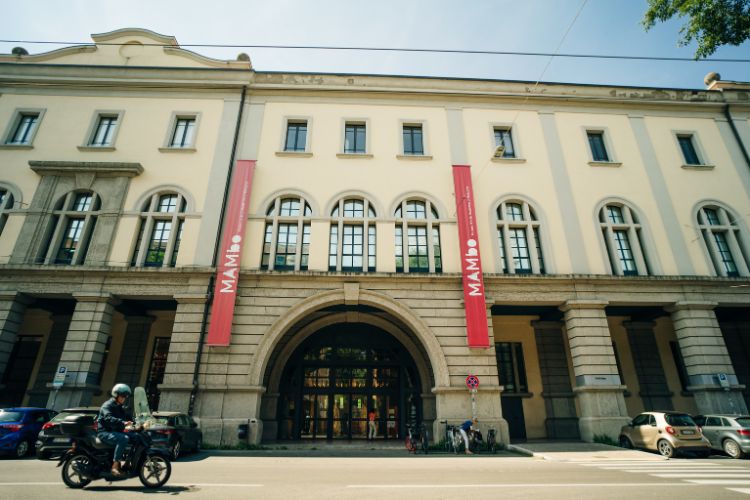
The Museum of Modern Art of Bologna, known to everyone as MAMbo, is a place that tells the story of Italian art, especially from the post-World War II era onwards. It is not just a gallery, but a true cultural centre that hosts permanent collections and temporary exhibitions, always with an eye on the most current trends.
The building itself, a former bread bakery, adds a unique charm to the space, transformed to accommodate contemporary creativity. It is a place where history meets innovation, making every visit a different experience.
You immediately sense that art here is not just to be looked at, but to be lived and felt. It is a reference point for anyone who wants to better understand the Italian and international artistic landscape of the 20th and 21st centuries. Its permanent collection, which starts from the post-war period and goes up to the present day, offers a fascinating journey through the social and cultural changes that have marked Italy.
MAMbo does not limit itself to exhibiting works, but seeks to create a dialogue between past and present, inviting reflection. It is a museum that is constantly renewing itself, just like the art it houses.
Thematic Itineraries and Key Works
Bologna's MAMbo is not just a container of works, but a true journey through the history of Italian art from the second half of the 20th century onwards. The permanent collection is organised into thematic itineraries that allow for the exploration of specific periods and movements, offering an in-depth view of artistic evolutions.
Art and Ideology: The Funeral of Togliatti
A significant starting point is the section dedicated to Roman painting of the 1960s, with a central work of great impact: Renato Guttuso's "Funerali di Togliatti" (Funeral of Togliatti). This monumental painting does not merely document a political event, but captures the emotional and ideological echo that the death of such a prominent public figure had on Italy. Around this work, there are contributions from other artists such as Giosetta Fioroni, Tano Festa, and Renato Mambor, who offer different perspectives on that decade.
Art and Action: 1977
Another itinerary explores the artistic and social ferment around 1977, a crucial year for Italian art. Here, one can admire works that reflect the experiments and demands of that period, often characterised by a strong link between art and direct action, with artists taking their research outside traditional spaces.
Focus on Contemporary Italian Art
The museum dedicates ample space to post-war Italian art, with particular attention to movements that marked a radical change. It moves from Arte Povera, with its material and conceptual research, to currents that explored new spatial and environmental perspectives, such as those that emerged from the 1968 Venice Biennale. Artists like Alighiero Boetti, with his works that play on language and contradiction, or Daniela Comani, with her "Sono stata io. Diario" (It was me. Diary), offer food for thought on the relationship between the individual and the collective.
New Acquisitions
Finally, the itinerary is enriched by "New Acquisitions," a section that serves as the museum's autobiography, showcasing the traces of artists who have animated MAMbo through temporary and monographic exhibitions in recent years. This space testifies to the museum's vitality and its commitment to documenting and promoting the most recent art.
The Morandi Collection at MAMbo Bologna
A Museum within a Museum
MAMbo houses a veritable museum dedicated to Giorgio Morandi, an addition that greatly enriches the visitor experience. This section, which is configured as a "museum within a museum," allows for a deep immersion into the life and works of one of the artists most closely associated with Bologna, the city where he lived and taught. It is a unique opportunity to understand the evolution of his artistic language.
Giorgio Morandi's Still Lifes
Morandi's output is renowned for its still lifes, subjects he explored throughout his career. Observing these works, one notices a progressive shift away from fresh flowers in favour of dried or silk ones, and a constant search for form and its placement in space. His compositions, often characterised by a sense of quiet and silence, recall principles of metaphysical painting while maintaining a completely personal stylistic signature. Echoes of artists like Cézanne and Picasso can be perceived, but reinterpreted in an intimate and contemplative way. The permanent collection of the Morandi Museum offers a comprehensive overview of this phase of his work.
Comparisons with Contemporary Art
One of MAMbo's most interesting curatorial choices is the juxtaposition of Morandi's works with those of contemporary artists. This exhibition strategy creates unexpected and stimulating dialogues, allowing Morandi's still lifes to be seen in a new light. A notable example is Tony Cragg's installation "Eroded Landscape," which in one of the final rooms of the exhibition is placed in relation to Morandi's works. The effect is to perceive almost a three-dimensional transposition of his paintings, a fusion of painting and sculpture that makes the visit particularly memorable.
Must-See Contemporary Artworks
"Ossi" by Claudia Losi
At MAMbo, among the most recent works, "Ossi" (Bones) by Claudia Losi, created in 2019, stands out. This installation reinterprets the shape of whale ribs, the largest animal in existence, transforming them into small huts. It is a work that evokes ancient stories and our relationship with nature.
"Senza titolo" by Garutti
Another work that deserves attention is Garutti's "Senza titolo" (Untitled). It consists of ten layers of carpet, cut to create shapes reminiscent of imaginary furniture. The artist uses these elements to define and describe spaces that are usually private and intimate, such as those in a home, bringing them into a new and unexpected context like that of the museum.
"Omaggio arbitrario a Brancusi" by Gilberto Zorio
Gilberto Zorio, a highly regarded artist, presents "Omaggio arbitrario a Brancusi" (Arbitrary Homage to Brancusi) from 1987. His works often use natural materials or elements that evoke distant times, such as stars and light. In this work, vases contain materials that seem to come from an ancient laboratory, creating a fascinating and almost magical effect.
"Il girasole" by Mario Ceroli
Finally, Mario Ceroli's "Il girasole" (The Sunflower), another example of Arte Povera, catches the eye. Ceroli is known for his wooden silhouettes, but here, while the material is recognisable, the focus shifts to the abstract form of the flower. The work suggests a deep connection between art, nature, and the human being.
Events, Installations, and Experiences at MAMbo
Performances and Presentations
MAMbo is not just a place to admire static works of art; it is a living space that pulses with creativity through performances and presentations. These occasions offer a direct insight into the artistic process and the ideas that animate the contemporary scene. Often, these are events that explore new forms of expression, involving the public in unexpected ways and stimulating reflection.
Interactive and Sound Installations
Among the museum's most engaging offerings are interactive and sound installations. These works invite the visitor not to be a mere spectator, but an integral part of the artistic experience. Sound installations, in particular, create an immersive environment that stimulates the senses, transforming the visit into a unique multisensory journey. It is a way to feel art, not just see it.
Educational Programmes and Active Participation
MAMbo actively strives to make art accessible to everyone, with a strong emphasis on educational programmes. These pathways are designed for different age groups and aim to stimulate curiosity and understanding of the contemporary artistic language. The goal is to encourage active participation from the public, transforming the museum into a place of learning and cultural exchange.
Practical Information for Your Visit
To best plan your visit to MAMbo, here is some useful information. Opening hours vary during the week, with the museum usually closed on Mondays. From Tuesday to Friday, you can visit in the afternoon, while on weekends the hours extend throughout the day. Regarding costs, the full ticket has a standard price, but reductions are available for certain categories of visitors. Furthermore, there is the possibility of free entry on some occasions, such as the first Sunday of the month. MAMbo is located at Via Don Minzoni 14, a central area of Bologna, easily accessible by public transport. If you are planning to explore various points of interest in the city, you might consider purchasing the Bologna Welcome Card, which offers benefits and discounts, including access to reduced rates for the museum. To reach the museum, you can consult the public transport information available here. Remember to always check the official website for the latest updates on opening hours and prices before you leave.